Guide
Couples Budget Template 2026: The System for Managing Money Together
By Dr. Alex Chen · Updated 2026-03-11
A couples budget template is a shared financial planning tool that lets both partners track income, expenses, savings goals, and who-pays-what in one place — eliminating money arguments and building wealth together. The best templates for 2026 include automatic expense splitting, goal tracking, and real-time syncing between partners.
Table of Contents

- Why Couples Need a Dedicated Budget Template
- What to Look for in a Couples Budget Template
- Free vs. Paid Couples Budget Templates Compared
- How to Set Up Your Couples Budget Template (Step-by-Step)
- The Best Couples Budget Templates for 2026
- How to Split Expenses Fairly as a Couple
- Common Couples Budgeting Mistakes to Avoid
- How to Have the Money Talk With Your Partner
- Setting Shared Financial Goals
- FAQs
- Sources
Why Couples Need a Dedicated Budget Template
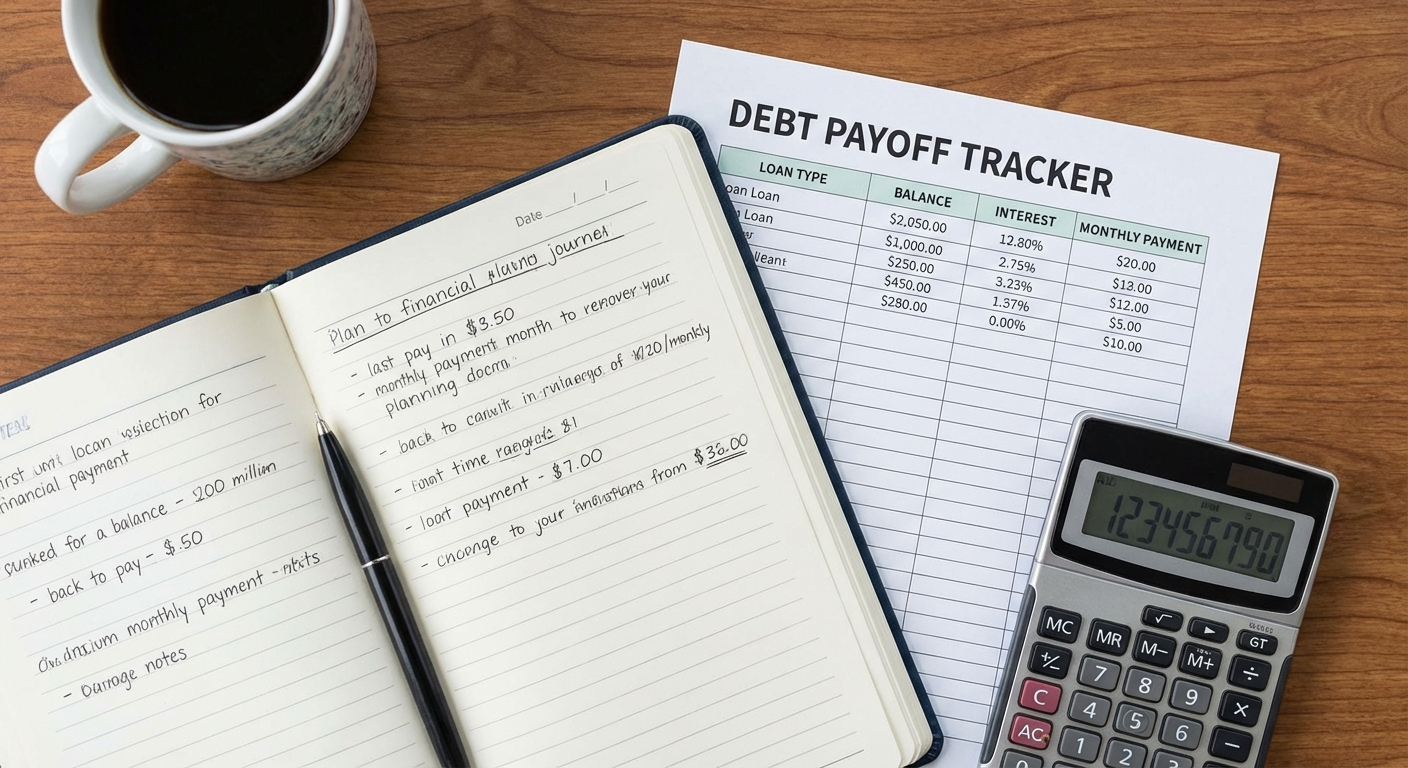
Budgeting as a single person is straightforward. You earn money, you spend money, you track both. But the moment two incomes, two spending habits, and two financial histories merge under one roof, a standard budget template falls apart.
A 2025 survey by the American Institute of CPAs found that money is the leading source of stress in relationships, with 73% of couples reporting financial tension at least once a month. The root cause is rarely the amount of money — it's the lack of a shared system.
A couples budget template solves this by giving both partners visibility into the full financial picture. Instead of one person managing the bills while the other feels left out (or left in the dark), both partners can see exactly where money is coming from, where it's going, and how close they are to shared goals.
Here's what a dedicated couples budget template does that a standard one doesn't:
- Tracks two incomes separately while combining them into a household total
- Assigns expenses so both partners know who's responsible for what
- Includes shared savings goals like emergency funds, vacations, or a home down payment
- Accounts for personal spending allowances so neither partner feels controlled
- Provides a communication framework for weekly or monthly money check-ins
Without a shared template, couples often fall into one of two traps: the "yours and mine" approach where nobody knows the full picture, or the "one person controls everything" model where resentment builds silently.
Neither works long-term. A couples budget template is the middle ground — shared visibility with individual autonomy.
What to Look for in a Couples Budget Template
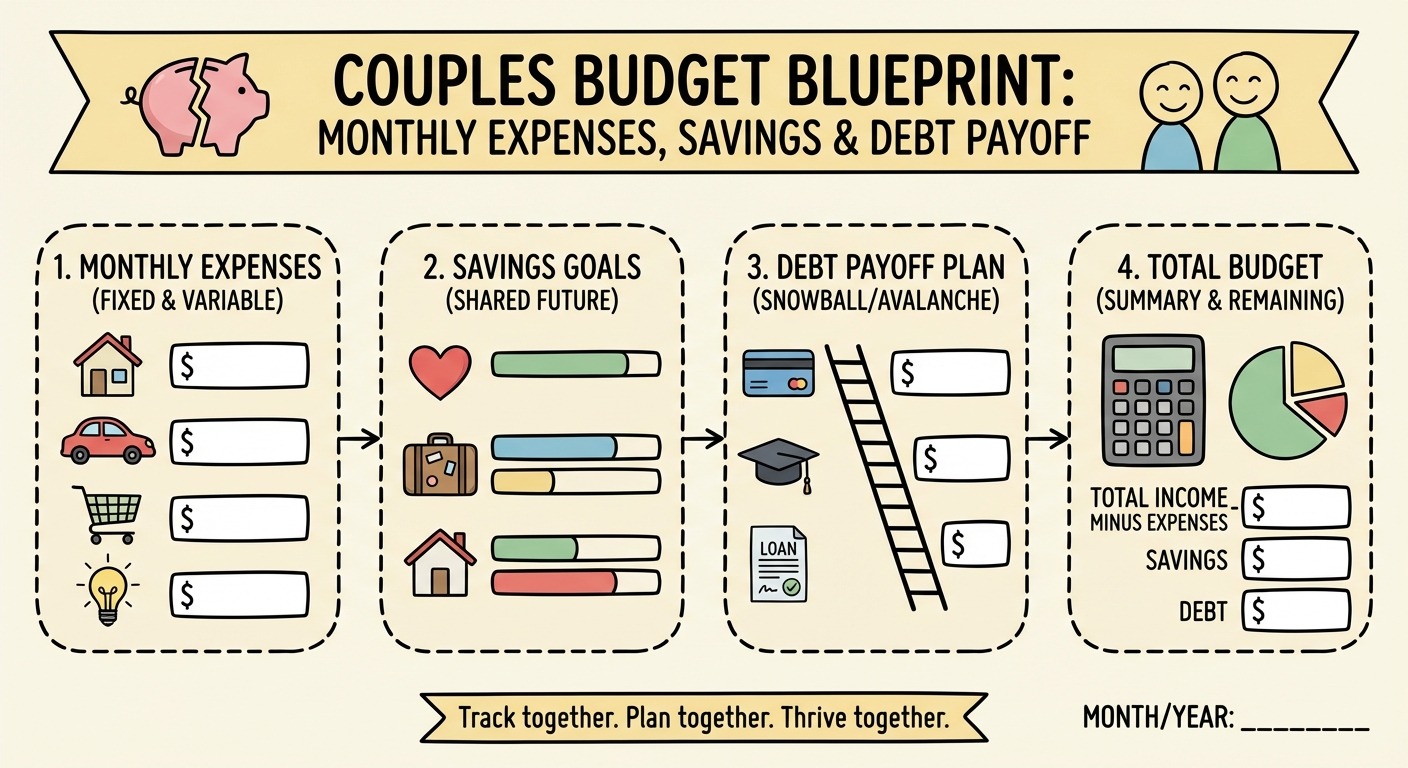
Not all budget templates work for couples. Before you download the first spreadsheet you find, make sure it includes these features:
Dual Income Tracking
Your template should have separate fields for Partner A's income and Partner B's income, including base salary, side hustles, bonuses, and any irregular income. The template should automatically calculate the combined household income.
Expense Categories That Reflect Couple Life
Single-person budgets don't account for shared rent, joint grocery runs, or couples' subscriptions. Your template needs categories like:
- Shared housing (rent/mortgage, utilities, insurance)
- Shared groceries and household supplies
- Joint subscriptions (streaming, gym family plans)
- Date nights and shared entertainment
- Individual personal spending (Partner A and Partner B)
- Joint savings contributions
- Individual retirement contributions
A Clear Splitting Method
The template should make it obvious how expenses are divided. Whether you split everything 50/50, proportional to income, or use a custom arrangement, the math should be built in.
Goal Tracking
Saving for a vacation? Building an emergency fund? Paying off student loans? Your template should have a dedicated section for tracking progress toward shared financial goals with target dates and milestone markers.
Simplicity
If it takes 45 minutes to update each week, you won't use it. The best couples budget template is one you'll actually stick with — which means it needs to be quick to update and easy to read at a glance.
Free vs. Paid Couples Budget Templates Compared
There's no shortage of budgeting tools for couples in 2026. The question is whether a free option gets the job done or a paid system is worth the investment. Here's an honest comparison:
| Feature | Free Templates (Google Sheets, Excel) | Paid Systems ($20–$50) |
|---|---|---|
| Dual income tracking | Manual setup required | Built in |
| Expense splitting calculator | Basic or DIY formulas | Automatic, multiple methods |
| Shared savings goal tracker | Limited | Visual dashboards with milestones |
| Real-time syncing | Google Sheets only | Yes, across devices |
| Automated categorization | No | Some systems offer this |
| Money date discussion prompts | No | Yes, guided check-in questions |
| Debt payoff integration | Separate spreadsheet needed | Integrated with budget |
| Net worth tracking | Separate spreadsheet needed | Integrated |
| Customization | High (if you know formulas) | Moderate (pre-built structure) |
| Time to set up | 1–3 hours | 15–30 minutes |
| Ongoing maintenance | Manual entry | Manual entry (some automation) |
| Cost | Free | $20–$50 one-time |
The Bottom Line
Free templates work well if you're comfortable with spreadsheets and willing to invest the setup time. Paid systems save you hours of setup and provide a more polished experience with guided workflows. For most couples, a one-time investment of $27 pays for itself within the first month by eliminating the guesswork and reducing money-related arguments.
How to Set Up Your Couples Budget Template (Step-by-Step)
Setting up a couples budget doesn't have to be a weekend project. Follow these steps to get your shared budget running in under an hour.
Step 1: Gather Your Financial Information
Before you open any template, both partners need to bring the following to the table:
- Last 3 months of bank statements
- Pay stubs or proof of income (all sources)
- List of recurring bills and subscriptions
- Outstanding debt balances and minimum payments
- Current savings and investment account balances
This step is about transparency. If one partner doesn't know about a credit card balance or a side income stream, the budget won't work.
Step 2: Choose Your Income Splitting Method
There are three main approaches:
50/50 Split — Each partner pays half of shared expenses, regardless of income. Simple but can feel unfair if there's a significant income gap.
Proportional Split — Each partner contributes a percentage of shared expenses proportional to their income. If Partner A earns 60% of household income, they pay 60% of shared costs. This is the most common method among couples we work with.
All-In Pool — All income goes into a joint account, and both partners receive an equal personal spending allowance. Everything else is shared. This requires the most trust but creates the strongest financial partnership.
Step 3: List Every Expense Category
Go through your bank statements and categorize every expense from the past 3 months. Group them into:
- Fixed shared expenses (rent, car payments, insurance)
- Variable shared expenses (groceries, utilities, dining out together)
- Partner A personal expenses (hobbies, personal subscriptions, individual purchases)
- Partner B personal expenses (same categories)
- Savings and debt payments (emergency fund, retirement, debt payoff)
Step 4: Set Your Shared Goals
Sit down together and identify 2–3 financial goals for the next 12 months. These might include:
- Building a $10,000 emergency fund
- Paying off $5,000 in credit card debt
- Saving $3,000 for a vacation
- Maxing out one partner's Roth IRA
Assign a monthly savings amount to each goal and build it into your budget as a non-negotiable "expense."
Step 5: Schedule Your First Money Date
A budget only works if you review it regularly. Set a recurring weekly or biweekly "money date" — 15 to 20 minutes where you sit down together, review spending, celebrate wins, and adjust as needed. Put it on the calendar. Treat it like any other important appointment.
The Best Couples Budget Templates for 2026
After testing dozens of options, here are the templates and systems that actually work for couples in 2026.
Google Sheets Couples Budget (Free)
Google Sheets is the most popular free option because both partners can edit the same spreadsheet in real time. You can find free couples budget templates on sites like Vertex42 and Template.net, or build your own from scratch.
Pros: Free, highly customizable, accessible from any device, real-time collaboration.
Cons: Requires manual data entry, no built-in guidance, can break if formulas are accidentally edited.
Microsoft Excel Couples Budget (Free with Office)
Excel offers more powerful formulas and charting than Google Sheets, but real-time collaboration is clunkier. It works best if one partner manages the spreadsheet and shares it during money dates.
Pros: Powerful formulas, works offline, more chart options.
Cons: Collaboration is limited, easy to break, steeper learning curve.
The Couples Budget System ($27)
A purpose-built budgeting system designed specifically for couples. It includes pre-built expense splitting (50/50, proportional, and custom), shared goal trackers, debt payoff calculators, net worth tracking, and guided money date discussion prompts.
Pros: Ready to use in 15 minutes, built for couples, includes guided discussion prompts, one-time purchase.
Cons: Less customizable than a DIY spreadsheet, one-time cost.
Budgeting Apps (Varies: Free–$15/month)
Apps like YNAB ($14.99/month), Goodbudget (free basic), and Honeydue (free) offer mobile-first budgeting with varying levels of couples features. YNAB is the most robust but requires a subscription. Honeydue is built for couples but lighter on features.
Pros: Mobile access, some automation, notification features.
Cons: Monthly costs add up, data privacy concerns, less control over structure.
How to Split Expenses Fairly as a Couple
Fair doesn't always mean equal. Here's how to find the right approach for your relationship.
The Income-Proportional Method (Most Popular)
Calculate each partner's share of household income, then apply that percentage to shared expenses.
Example: Combined household income is $10,000/month. Partner A earns $6,000 (60%), Partner B earns $4,000 (40%). Shared expenses total $5,000/month. Partner A pays $3,000, Partner B pays $2,000.
This method accounts for income differences and feels fair to most couples. It's especially useful when one partner earns significantly more or when one partner is in school, between jobs, or working part-time to care for children.
The 50/50 Method
Each partner pays exactly half of shared expenses. Whatever is left over is their personal money to save or spend as they choose.
This works best when both partners earn similar incomes and value financial independence within the relationship. It can create tension if there's a large income gap.
The All-In Method
All income goes into a shared pool. Bills are paid from the pool. Each partner gets an equal "fun money" allowance. Everything else goes to shared savings and goals.
This method creates the strongest sense of financial partnership but requires a high level of trust and communication. It's most common among married couples who view all income as "ours."
The Hybrid Method
Some expenses are split (rent, utilities), some are individual (personal subscriptions, hobbies), and savings goals are contributed to proportionally. This is a flexible approach that many couples settle into after trying other methods.
There's no universally "right" method. The best approach is the one both partners agree to and feel good about.
Common Couples Budgeting Mistakes to Avoid
Mistake 1: Not Including Personal Spending Allowances
Every budget needs breathing room. If one or both partners feel like they can't buy a coffee without justifying it, the budget will fail. Build in personal spending for both partners — no questions asked.
Mistake 2: Setting Goals Without Timelines
"Save for a house" is not a goal. "Save $40,000 for a down payment by December 2027" is a goal. Without a timeline and a specific number, you can't track progress or adjust your plan.
Mistake 3: Only One Partner Managing the Budget
Even if one partner is more financially savvy, both partners need to be involved. The money date is non-negotiable. When one partner is excluded, resentment and financial blind spots grow.
Mistake 4: Not Accounting for Irregular Expenses
Car maintenance, holiday gifts, annual insurance premiums, veterinary bills — these expenses are predictable even if they don't happen monthly. Divide annual irregular expenses by 12 and budget for them monthly in a "sinking fund."
Mistake 5: Treating the Budget as Rigid
A budget is a living document. Income changes, expenses shift, priorities evolve. Review and adjust your budget at least quarterly, and whenever there's a major life change (new job, baby, move).
How to Have the Money Talk With Your Partner
Starting the money conversation can feel uncomfortable, but it doesn't have to be confrontational. Here are practical ways to approach it:
Start with shared dreams. Instead of opening with "we need to talk about money," try "I've been thinking about our future — where do you see us in 5 years?" Financial goals flow naturally from life goals.
Be honest about your financial past. Share your debts, your credit score, and your money habits — good and bad. Vulnerability builds trust.
Use a template as a neutral tool. A budget template isn't about controlling each other. It's a shared tool that keeps both partners informed. Frame it that way.
Schedule regular check-ins. One big conversation isn't enough. Weekly or biweekly money dates (15–20 minutes) keep you aligned and prevent small issues from becoming big fights.
Celebrate progress. When you hit a savings milestone, pay off a debt, or stick to the budget for a full month, celebrate together. Positive reinforcement makes budgeting feel rewarding instead of restrictive.
Setting Shared Financial Goals
The best couples budget template is only as good as the goals driving it. Here's a framework for setting goals together:
Short-Term Goals (0–12 Months)
- Build or replenish an emergency fund (3–6 months of expenses)
- Pay off high-interest credit card debt
- Save for a specific purchase or vacation
- Create a budget and stick to it for 3 consecutive months
Medium-Term Goals (1–5 Years)
- Save for a home down payment
- Pay off student loans or car loans
- Build investments to a specific milestone
- Start or grow a side business
Long-Term Goals (5+ Years)
- Max out retirement contributions annually
- Achieve a specific net worth target
- Pay off a mortgage early
- Build college savings for children
- Reach financial independence
For each goal, define: the specific target amount, the monthly contribution required, the target date, and which account the savings will be held in. Track all of these in your couples budget template.
Ready to stop fighting about money and start building wealth together?
The Couples Budget System gives you everything you need: pre-built expense splitting, shared goal trackers, debt payoff calculators, and guided money date prompts — all for a one-time purchase of $27.
FAQs
What is the best couples budget template for 2026?
The best couples budget template depends on your preferences. For a free option, Google Sheets offers real-time collaboration and customization. For a ready-made solution, the Couples Budget System ($27) provides pre-built expense splitting, goal tracking, and guided money date prompts specifically designed for couples.
How should couples split finances?
The most popular method is the income-proportional split, where each partner contributes a percentage of shared expenses equal to their share of household income. Other options include a 50/50 split, an all-in pool, or a hybrid approach. The right method is the one both partners agree to and feel is fair.
How often should couples review their budget?
Couples should review their budget weekly or biweekly during a scheduled "money date" of 15–20 minutes. A more thorough review — including goal progress, net worth updates, and any needed adjustments — should happen monthly or quarterly.
Should couples have joint or separate bank accounts?
There's no single right answer. Many financial planners recommend a hybrid approach: one joint account for shared expenses and savings, plus individual accounts for personal spending. This provides transparency for shared goals while preserving financial autonomy for both partners.
How do you start budgeting as a couple if you've never done it before?
Start by having an open conversation about financial goals and concerns. Gather 3 months of bank statements, list all income and expenses, choose an expense-splitting method, and set 2–3 shared goals. Use a couples budget template to organize everything, and schedule a weekly money date to review progress together.
Sources
- American Institute of CPAs. "2025 Financial Stress Survey: Finances in Relationships." AICPA, 2025.
- Bureau of Labor Statistics. "Consumer Expenditure Survey, 2024–2025." U.S. Department of Labor, 2025.
- Ramsey Solutions. "The State of Money in American Households." Ramsey Solutions Research, 2025.
- National Endowment for Financial Education. "Couples and Money: Communication Strategies." NEFE, 2024.
- Federal Reserve Board. "Economic Well-Being of U.S. Households Report, 2024." Board of Governors of the Federal Reserve System, 2025.